


Why It Matters: Access for anglers is critical to sustaining participation in recreational fishing. Impediments to access come in many forms, and last week, Congress advanced two priority bills for the Congressional Sportsmen’s Foundation (CSF) that will benefit anglers and improve angling access, though in very different ways.
Highlights:
- The National Oceanic and Atmospheric Administration (NOAA) has jurisdictional authority of our nation’s marine fisheries resources from the limit of a state or territorial sea (typically 3 or 9 miles from shore) out to the 200-mile limit of the exclusive economic zone (EEZ). A lot of water – a lot of rules! The Modernizing Access to Our Public Oceans Act (MAPOceans Act) will provide much-needed clarity to those rules.
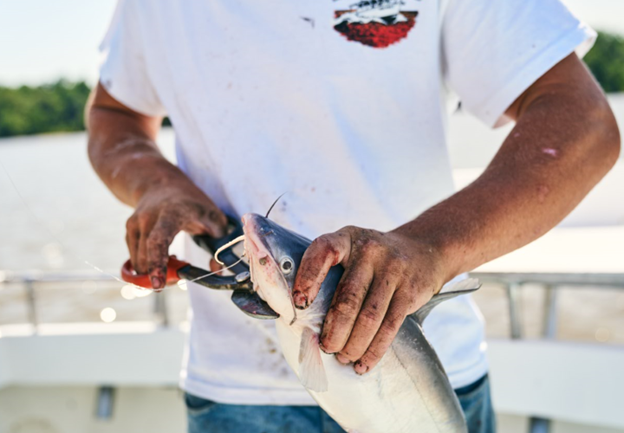
- Although a popular target species for anglers in other areas of the country where they are native, blue catfish are an invasive species in the Chesapeake Bay (Bay) and present a threat to the Bay’s fragile ecosystem.
Last week, the House Committee on Natural Resources sent two CSF-priority pieces of legislation that would benefit angler access to the full House of Representatives for consideration. One bill seeks to clarify information on where and how we can fish in waters managed by NOAA’s National Marine Fisheries Service, while the other will significantly boost efforts to get a handle on an invasive species in the Chesapeake Bay that has deleterious impacts on native species, like striped bass.
H.R. 3340, the MAPOceans Act, will direct NOAA to digitize and make available to the public any access or recreational use restrictions on marine waters under the agency’s jurisdiction. These restrictions often include areas closed to fishing or with species-specific seasonal closures, allowable gear or bait types, types of propulsion allowed, marine protected areas, etc. From a recreational fishing perspective alone, NOAA’s eight Regional Fishery Management Councils have implemented 46 management plans covering 460 fish stocks or stock complexes that create a mosaic of fishing regulations and restrictions. These regulations are often location-specific and can be cumbersome to understand and a barrier to access. The Senate version of MAPOceans has already cleared that chamber.
H.R. 4294, the Mitigation Action and Watermen Support Act of 2025 (MAWS Act) creates an innovative pilot program to facilitate a commercial market for the highly invasive and problematic blue catfish in the Chesapeake Bay, providing a significant boost for efforts to control the invasive species and restore the Bay’s natural ecosystem. Blue catfish are popular among many anglers in their native range, but in recent years, their rapid expansion in the Chesapeake Bay where they do not belong is putting additional negative pressures on the Bay’s native aquatic species like striped bass and oysters. The bill would establish a new market for these catfish in the pet food industry, while incentivizing the Bay’s watermen to harvest the fish and be a big part of the solution.
CSF greatly appreciates the leadership of Congressional Sportsmen’s Caucus (CSC) Member Representative Fry, CSC Co-Chair Rep. Panetta, and Rep. Levin on MAPOceans, and Rep. Elfreth and CSC Member Rep. Wittman on the MAWS Act of 2025. We look forward to working with these sponsors to advance these bills to the President’s desk in 2026.


