
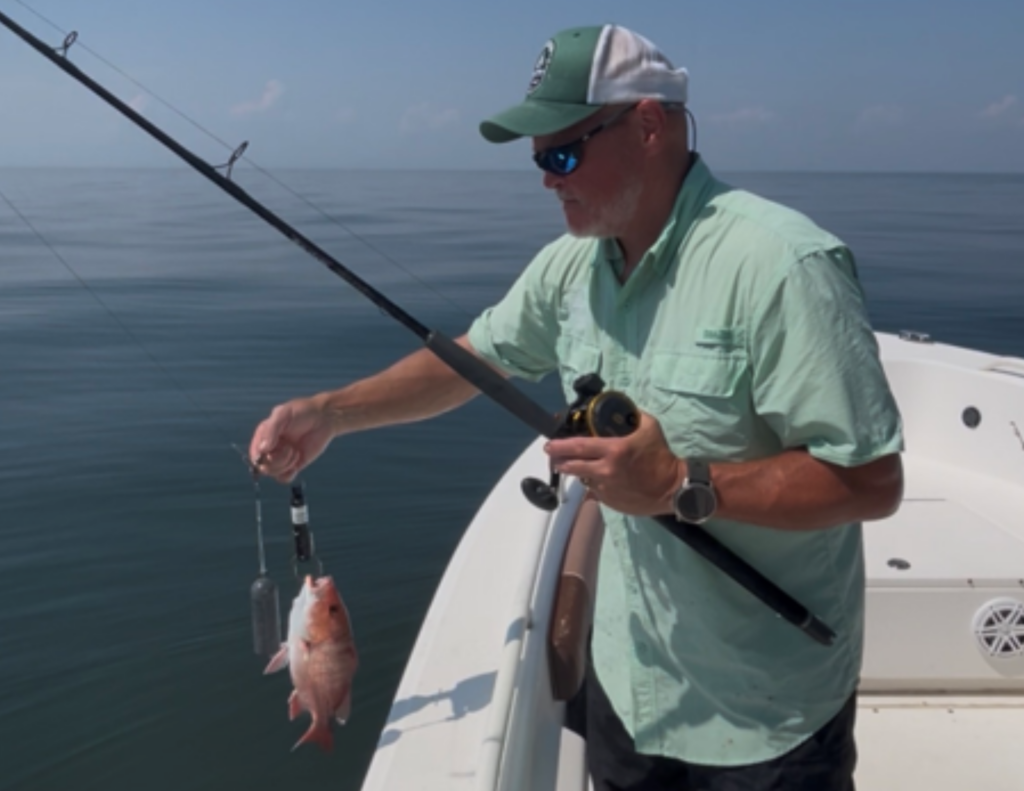
Why It Matters: Descending devices are best known for helping deep-caught reef fish recover from barotrauma or “the bends”, but they can also move released fish quickly past sharks and dolphins waiting near the surface. Reducing depredation and improving the survival of regulatory discards means more fish in the water and potentially better fishing opportunities in the future.
Highlights:
- In addition to sharks, dolphins are becoming increasingly problematic for eating (known as depredating) reef fish released at the boat.
- A growing body of research indicates that when anglers use a descending device to send their fish back down, depredation is exceedingly rare and may be substantially less likely than predation following an unassisted release at the surface.
Descending devices have traditionally been promoted or required as a way to address barotrauma, which is when deep-caught reef fish experience expanded gases inside their bodies as they are rapidly brought to the surface. By returning a fish to depth, where increased pressure recompresses those gases, a descending device allows the fish to regain its equilibrium and swim away. Recognizing this conservation benefit, Congress enacted the DESCEND Act in 2021, requiring a descending device or venting tool to be rigged and ready when fishing for reef fish in federal waters of the Gulf of America. Before that requirement expired in January 2026, the Gulf Fishery Management Council recommended continuing the measure, an action strongly supported by the Congressional Sportsmen’s Foundation.
However, barotrauma is not the only threat facing released reef fish. Sharks frequently take fish as they are brought to the boat — a problem commonly known as “paying the taxman” — while dolphins in parts of the northern Gulf have learned to follow fishing vessels and occasionally intercept fish being caught, as well as frequently catching regulatory discards released at the surface. During a recent trip south of Dauphin Island, Alabama, several dolphins followed our boat as we searched for reefs holding harvestable-sized red snapper. Rather than releasing undersized red snapper at the surface, where the dolphins were waiting for an easy meal, I used a descending device to carry each fish quickly back toward the bottom. Despite the dolphins’ persistence, I did not see or feel a single fish being taken during descent.
Skeptics sometimes argue that attaching a fish to a descending device merely creates a “treat tether” for sharks or dolphins, but recent presentations on ongoing research tells a different story. In one northern Gulf study, researchers recorded 69 depredation events as fish were brought toward the surface, including 54 involving sharks and 15 involving bottlenose dolphins. Yet, across 1,096 recorded descender releases in the same region, researchers observed no depredation. A subsequent Gulf-wide study used underwater cameras to document nearly 1,000 usable descents and recorded only three depredation events or roughly 0.3% of the fish released. Researchers suggest that fish on descending devices attract less attention because they remain comparatively motionless and pass rapidly through the upper water column, where predators often wait for struggling or disoriented fish.
Moving to another location remains the best response when sharks or dolphins begin taking hooked fish or those released at the surface, both to reduce unnecessary fish mortality and to avoid further conditioning predators to associate boats with food. When persistent dolphins follow the boat, however, or when a regulatory discard is struggling at the surface, a descending device provides anglers with another valuable option to return that fish alive and well. No release technique can guarantee survival, but a growing body of science indicates that descending devices can do more than mitigate barotrauma. They can also help fish get past waiting predators and return safely to the reef, giving anglers a better chance to catch those fish again another day.