
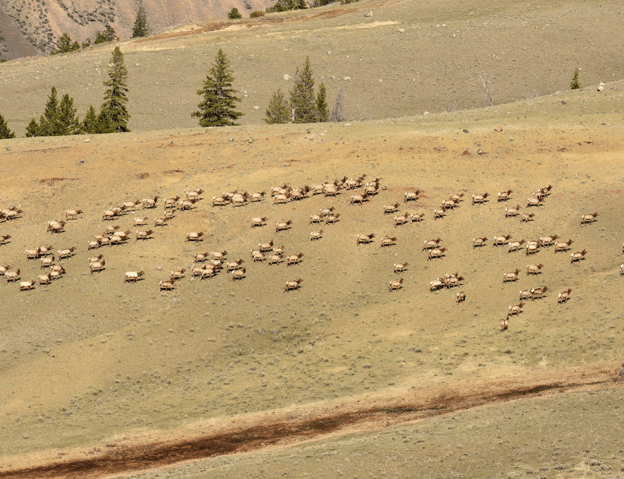
Why It Matters: Healthy big-game populations depend on access to quality seasonal habitat and the ability to move between those areas. The Congressional Sportsmen’s Foundation (CSF) continues to support state-led, science-informed, voluntary conservation efforts that improve habitat connectivity while respecting private property rights, maintaining working landscapes, and supporting hunting opportunities across the West.
Highlights:
- The projects are expected to improve habitat management on more than 206,000 acres, restore more than 40,000 acres, and address 225 miles of fencing to improve wildlife movement.
- The investments support practical, on-the-ground conservation informed by state wildlife priorities and carried out through voluntary partnerships with landowners and other stakeholders.
For sportsmen and women across the West, healthy populations of elk, mule deer, pronghorn, and other big-game species depend on quality habitat throughout the year. As state wildlife agencies continue to improve their understanding of seasonal movements through GPS collars, mapping, and other technologies, that information helps target conservation work where it could have the greatest benefit for wildlife and hunters.
CSF has long supported voluntary, state-led efforts to improve habitat connectivity and wildlife movement across the West. Pairing state wildlife science with willing landowners and other partners can help address habitat needs and barriers to movement while respecting private property rights and avoiding unnecessary restrictions on existing land uses.
NFWF, in partnership with the Department of the Interior and other public and private partners, announced $13.3 million for 14 grants that will fund projects to conserve critical winter ranges and migration habitat for big-game species. Combined with $3.8 million in matching contributions, the grants represent $17.1 million in conservation investments across 11 Western states.
These investments will support practical habitat work, including restoring seasonal ranges, treating invasive vegetation and conifer encroachment, and modifying fencing that can impede wildlife movement. Together, the projects supported by these grants are expected to improve habitat management on more than 206,000 acres, restore more than 40,000 acres, and remove, install, or improve 225 miles of fencing. The broader program also supports voluntary conservation agreements and other cooperative efforts with willing landowners.
Investments like these demonstrate how state-informed science and voluntary partnerships can be translated into targeted conservation on the ground. This collaborative approach can help sustain healthy big-game populations and the hunting opportunities that depend on them while maintaining the working landscapes that are important to Western communities.