
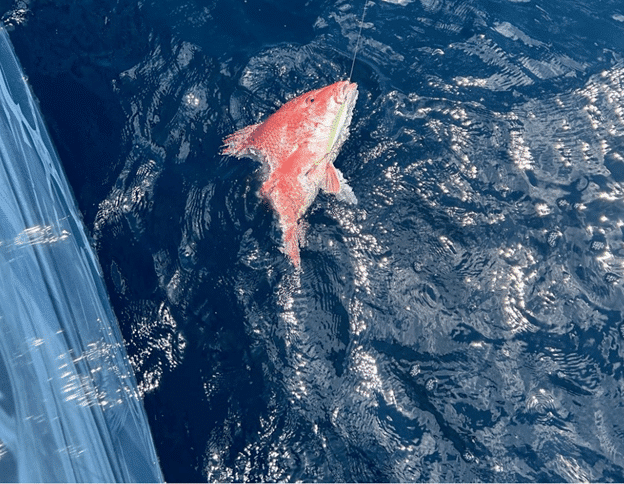
Why It Matters: Shark depredation has become a significant and growing challenge for recreational saltwater anglers and commercial fishermen, affecting fishing success, increasing fish mortality, and creating frustration on the water. While Congress is on the verge of approving landmark legislation to coordinate research and management recommendations, the National Oceanic and Atmospheric Administration (NOAA) Fisheries recently announced the formation of an internal team of scientists to better understand the problem and explore potential solutions. Together, these efforts represent the strongest federal commitment yet to addressing shark depredation while maintaining healthy shark populations and sustainable fisheries.
Highlights:
- The House-passed SHARKED Act is just one Senate vote away from reaching the President’s desk if the Senate takes up the House version after returning from the August recess.
- NOAA Fisheries recently launched a Shark Depredation Strategy Committee to guide research and evaluate science-based mitigation measures.
- The Congressional Sportsmen’s Foundation (CSF) will continue advocating for passage of the SHARKED Act while engaging with NOAA Fisheries to help develop effective shark depredation solutions.
For the last several years, anglers across the Atlantic, Gulf of America, Pacific, and Caribbean have reported increasing encounters with sharks intercepting hooked fish before they can be landed. These interactions not only diminish the recreational fishing experience but can also increase discard mortality, damage fishing gear, and complicate fisheries management by contributing to an unknown level of fishing mortality for target species. As the problem has grown, so too has the call for a coordinated federal response.
From the Capitol Hill perspective, Congress is closer than ever to delivering that response. The House of Representatives has already passed H.R. 207, the Supporting the Health of Aquatic Systems through Research, Knowledge, and Enhanced Dialogue (SHARKED) Act, while the Senate version (S. 2314) of the same bill has cleared the Senate Commerce Committee. If the Senate takes up the House-passed bill following its August recess, there is only one more vote necessary to send the legislation to the President’s desk. The bipartisan legislation would establish a non-regulatory task force to improve coordination among federal and state agencies, researchers, and stakeholders while providing recommendations for practical solutions to reduce shark depredation.
Even before congressional action is complete, NOAA Fisheries has begun laying the groundwork for a strategy from the agency’s perspective. Earlier this month, the agency announced its Shark Depredation Strategy Committee, a leadership team charged with developing a comprehensive strategy to better understand why depredation is increasing and which mitigation measures may prove most effective. The initiative includes research into shark abundance, shark behavior around fishing activity, the effectiveness of deterrent technologies, and how existing shark management frameworks may influence depredation rates. NOAA also plans to expand cooperative research with recreational anglers, charter captains, commercial fishermen, universities, and state agencies.
CSF supports a science-driven approach to shark depredation that balances healthy shark populations with abundant recreational fishing – and landing – opportunities. As federal momentum continues to build, CSF will continue working with congressional champions to secure final passage of the SHARKED Act while also engaging with NOAA Fisheries as it develops and implements a national shark depredation mitigation strategy.