
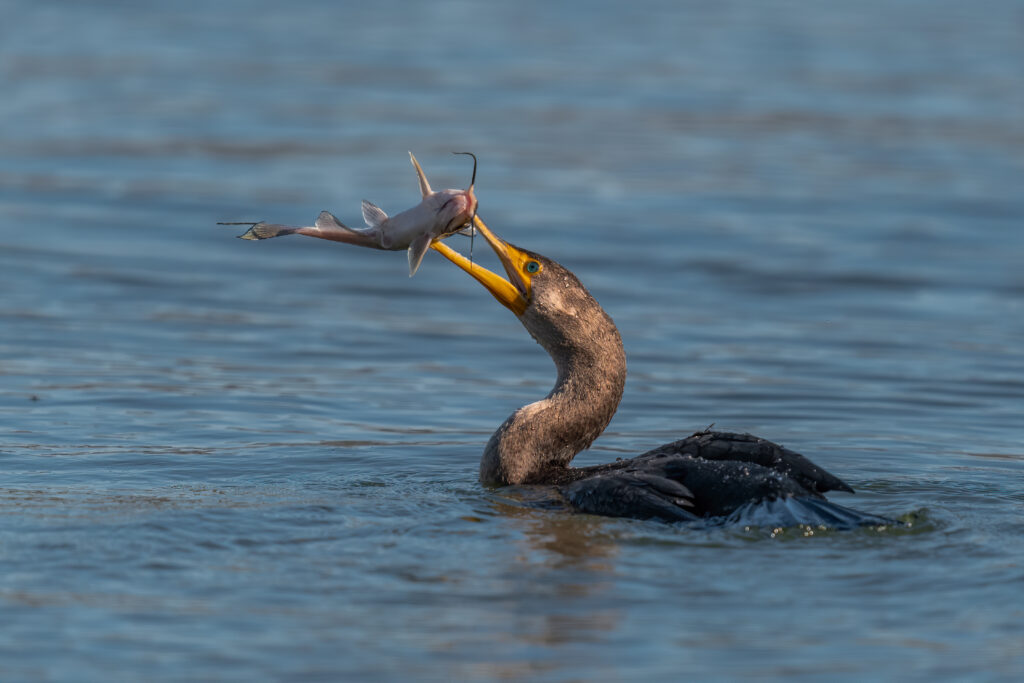
Why It Matters: Overabundant double-crested cormorant populations are creating growing challenges for fisheries, aquaculture, and habitat health across the country. Providing states with flexible, science-based management tools ensures localized issues can be addressed effectively while maintaining sustainable population levels. This legislation represents a proactive step toward balancing conservation success with on-the-ground realities.
Highlights:
- The Responsible Cormorant Management and Control Act of 2026 was recently introduced by Representative Tim Walberg, a member of the Congressional Sportsmen’s Caucus.
- The bill would establish a science-based framework for managing double-crested cormorant populations.
- The bill would also delegate management authority to states to address localized overabundance.
- Moreover, this Act builds on proven waterfowl management models that support hunting as an integral tool for conservation.
Last week, Congressional Sportsmen’s Caucus member, Representative Tim Walberg (MI) introduced the Responsible Cormorant Management and Control Act of 2026 –legislation designed to provide states with greater flexibility to manage localized populations of double-crested cormorants that are increasingly impacting fisheries and shoreline habitats.
“The rapid recovery and proliferation of double crested cormorant populations create challenges for not only public and private aquaculture facilities but also for fisheries and land managers in many cases,” said Taylor Schmitz, Senior Vice President of the Congressional Sportsmen’s Foundation (CSF). “The Responsible Cormorant Management and Control Act provides a science-based, proven framework approach to delegating management authority to the states where needed. CSF appreciates Rep. Walberg for his leadership in developing a workable solution to a growing concern among anglers across the country.”
Since the 1980s, double-crested cormorant populations have rebounded significantly following the banning of DDT and protections under the Migratory Bird Treaty Act (MBTA). While this recovery represents a conservation success story, population growth in certain regions has led to unintended consequences, including increased predation on juvenile fish that can limit recruitment in both recreational and commercial fisheries.
Beyond fisheries impacts, cormorants can also significantly alter local ecosystems. As colonial nesters, their large breeding sites often result in defoliation of trees and surrounding vegetation, leading to habitat degradation, erosion, and the loss of sensitive plant and wildlife communities.
The legislation would amend the MBTA and direct the U.S. Fish and Wildlife Service, in coordination with Regional Flyway Councils, to develop a management framework that maintains cormorant populations above sustainable thresholds while empowering states to address issues of localized overabundance. This approach mirrors the successful adaptive management model used for waterfowl, which has supported strong population levels alongside recreational opportunities.
The Congressional Sportsmen’s Foundation looks forward to working with Rep. Walberg and congressional partners to advance this commonsense, science-driven wildlife management solution that supports both conservation objectives and the needs of fisheries managers and anglers.