
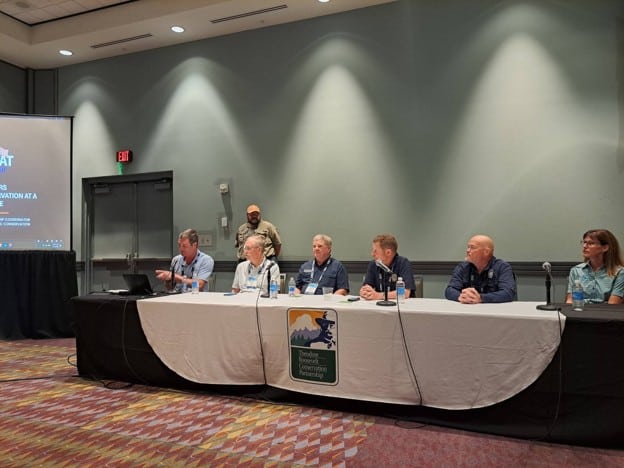
Why It Matters: Healthy aquatic habitats are the foundation of abundant, sustainable fisheries and ample fishing opportunities for America’s anglers. For two decades, the National Fish Habitat Partnership (NFHP) has united federal and state agencies, fishing conservation organizations, industry, local communities, and private landowners behind a common goal: restoring, protecting, and enhancing the waters that support fish and fishing opportunities. As the recreational fishing community continues to face challenges ranging from habitat degradation to changing environmental conditions, the NFHP’s collaborative, science-driven, and strategic approach provides an effective mechanism for achieving conservation successes. The Congressional Sportsmen’s Foundation (CSF) had the opportunity to serve as a panelist at last week’s ICAST that highlighted the importance of NFHP for the future or our fisheries resources.
Highlights
- The NFHP strategically coordinates habitat restoration and conservation efforts through 20 Fish Habitat Partnerships that collectively encompass every region of the United States and address each area’s unique aquatic habitat needs.
- During last week’s Theodore Roosevelt Conservation Partnership (TRCP) 2026 ICAST Conservation Summit, CSF’s Chris Horton had an opportunity to provide his perspective on NFHP’s importance and achievements over the last 20 years.
This year marks the 20th anniversary of NFHP, and during TRCP’s annual ICAST Conservation Summit last week in Orlando, leaders from across the recreational fishing conservation community came together to reflect on one of the nation’s most successful collaborative aquatic conservation efforts.
Established in 2006, the National Fish Habitat Partnership was created to address a growing recognition that a more strategic and coordinated approach was needed to effectively restore, enhance, and protect the habitats that support healthy fisheries resources. While fish populations are managed on a species-by-species basis, the health of those fisheries ultimately depends on the quality and connectivity of the habitats that sustain them. Rather than relying on a one-size-fits-all approach, NFHP was designed to strategically identify the most pressing aquatic habitat challenges across the country and develop locally driven conservation solutions supported by the best available science.
A defining feature of the NFHP is its network of 20 Fish Habitat Partnerships, each focused on the unique ecological conditions and conservation priorities within a specific geographic region, aquatic system, or species group. Collectively, these partnerships provide nationwide coverage, ensuring that conservation efforts are tailored to local waters while contributing to broader national objectives at the landscape scale. This structure allows federal and state fish and wildlife agencies, Tribal governments, local communities, conservation organizations, industry partners, and private landowners to collaborate on projects that restore streams, lakes and reservoirs, reconnect fragmented rivers, improve water quality, remove barriers to fish passage, and conserve critical aquatic habitats using a bottom-up rather than a top-down approach.
During the panel discussion, CSF’s Senior Director of Fisheries Policy and NFHP board member Chris Horton was asked what he has seen as limiting factors to aquatic habitat restoration over his career. “I think it was the lack of a coordinated, strategic vision to address habitat needs at a landscape level. That’s essentially why NFHP was created,” said Horton. “We are on the second iteration of a national assessment of our waters, identifying those that are severely impaired as well as those that are in good shape and that we need to keep that way. Now, we have a better handle on where the work is needed most, and we have a network of 20 FHPs that can get it done with adequate funding.”
Over the past 20 years, the NFHP Fish Habitat Partnerships have been able to leverage a mere $7.2 million annual program appropriation (not all of which is available for projects) to implement over $170 million in on-the-ground projects. With additional funding, the strategic and targeted aquatic habitat restoration mechanism provided through NFHP will be the driving force behind largescale, measurable restoration and enhancement of our nation’s fisheries.
As the NFHP enters its third decade, CSF remains committed to securing the reauthorization and enhanced funding this critical program needs to restore and improve our aquatic resources and provide better fishing opportunities for America’s anglers.