
*This article was written in partnership with the Coastal Conservation Association
Chris Horton, Congressional Sportsmen’s Foundation
Brad Gentner, Coastal Conservation Association
Why It Matters: NOAA Fisheries is no longer including durable goods expenditures, such as boats, trailers, electronics, and fishing tackle, in its state-level estimates of recreational fishing expenditures. As a result, the economic footprint of recreational fishing presented to the Gulf Council is significantly understated, at precisely the wrong time. With a new red snapper stock assessment underway and potentially consequential allocation decisions on the horizon, it is critical that recreational fishing’s full economic contribution is accurately represented.
Highlights:
- More than half of recreational fishing’s economic value may be missing from current state-level estimates. NOAA Fisheries’ current figures include trip expenditures but omit durable goods, which typically account for more than 60% of total economic impact.
- The Gulf Council is preparing for potentially contentious red snapper allocation decisions among commercial, for-hire, and private recreational sectors, and incomplete economic data puts the recreational sector at a distinct disadvantage.
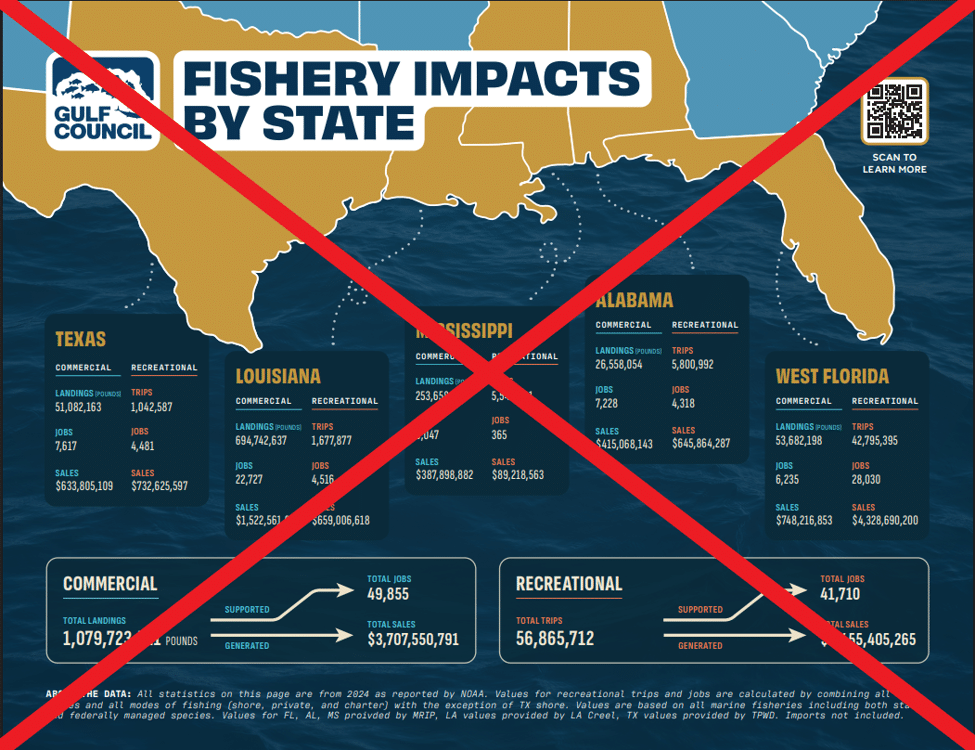
At last week’s Gulf Council (Council) meeting in Biloxi, MS, Council members were presented with an infographic comparing the economic value of commercial and recreational fishing in the Gulf, which were roughly similar. Inappropriately, the information that was presented was incomplete and therefore misleading. Similar infographics have been produced for every council, all with the same giant omission.
The economic impact of recreational fishing should include two distinct measures of spending activity: trip expenditures and durable goods. Trip expenditures are just that, how much we as anglers spend on a fishing trip and services (lodging, guides, gas, ice, terminal tackle, etc.). The durable goods category includes major expenses, like boats, trailers, marine electronics, rods, and reels. Clearly, the durable goods category represents our biggest expense when it comes to any type of fishing, saltwater or freshwater. That is why it is troubling that NOAA Fisheries not only omitted the durable goods category in the total recreational spending values by state that were presented in the graphic but also failed to acknowledge that more than half the value of recreational fishing is no longer a part of their estimates, only trip expenditures.
2018 was the last year that durable goods expenditures were broken out by state. Using Louisiana as an example, in 2018 the estimated trip expenditures in that state were $629 million, and durable goods expenditures were $1.3 billion for a total economic impact of $1.929 billion. The infographic presented at the Council last week would lead you to believe that the total economic impact of the recreational sector in Louisiana was only $659 million in 2025, without any indication that this figure represents less than one half of the equation.
Unless corrected, NOAA Fisheries’ new direction of ignoring durable expenditures, and effectively establishing a new, much lower baseline for recreational values, could have significant ramifications on fisheries management decisions.
The timing is particularly concerning. At last week’s meeting, Council staff highlighted the looming allocation battle for red snapper resources following completion of the red snapper stock assessment that is currently underway. The commercial and recreational sector allocations will be considered first. The current 51% commercial vs. 49% recreational split in the red snapper fishery has been rusted-shut since 1990. Once that decision has been made, changes in the current allocation between the federal charter/for-hire fleet (42.3%) and private anglers (57.7%) will be debated next. The state-by-state allocation of the private recreational component will be the final decision point.
Allocation decisions are by far the most contentious and difficult decisions that a regional fishery management council makes. The Gulf Council will be facing not one, not two, but three different allocations for a single fishery. Economics alone cannot be the sole basis for an allocation decision, but economics clearly play an important role. NOAA Fisheries owes millions of saltwater anglers who contribute to the Gulf’s economy to get the numbers right, particularly as these consequential allocation decisions approach. Anglers should not have to enter these imminent, controversial debates with one hand tied behind our backs.
As always, the Congressional Sportsmen’s Foundation and the Coastal Conservation Association will be there to ensure recreational anglers have a seat at the table and receive a just allocation of our fisheries resources.