
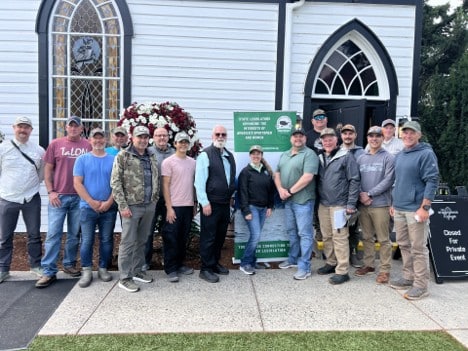
Why It Matters: Shared rivers demand shared decisions. The Columbia River is managed across two states, two legislatures, and two fish and wildlife agencies, and the outcome of the decisions made by those entities determines whether salmon season stays open for the families who fish on the Columbia River each year. The Oregon and Washington Legislative Sportsmen’s Caucuses hosted their annual joint fishing event, bringing together legislators, sporting coalition partners, fish and wildlife agencies, and community members from both states. This event provided policymakers an opportunity to hear about the benefits and impacts of ongoing fisheries management efforts in the region.
Highlights:
- On September 14, 2026, Oregon and Washington Legislative Sportsmen’s Caucus members launched from Ridgefield, Washington for the annual Columbia River Fishing Day.
- The morning’s fishing trip was followed by a luncheon which featured briefings from ODFW, WDFW, the Congressional Sportsmen’s Foundation (CSF), partner nonprofits, and community members.
- CSF and coalition partners helped the caucus convene the bipartisan gathering so legislators could learn about Columbia River management directly from agencies and anglers.
Before sunrise on September 14, 2026, boats slipped off the Ridgefield launch and into a busy salmon fishing season. Oregon and Washington Legislative Sportsmen’s Caucus members, coalition partners, and community guests spent the morning chasing fall salmon on water that does not recognize a state line. Volunteers from the Association of Northwest Steelheaders hosted legislators and community members in their boats, shared gear, and talked through what a good bite and a closed season actually feel like when you make a living or chase your passions on this stretch of the Columbia River.
That is one of the main goals of the annual Columbia River Fishing Day: to bring together policymakers with the community members impacted by those policies. Fisheries management frameworks in the area are set through a complex web of management authorities: the Compact, North of Falcon, two separate fish and wildlife agencies, and two state legislatures that are all working to balance quotas with population management goals, in addition to hatcheries, enforcement, habitat, funding, ESA constraints, and other considerations.
After a successful morning on the water, the conversation continued as participants headed to the Neighborhood Refuge in downtown Ridgefield for a lunch sponsored by the Congressional Sportsmen’s Foundation, American Sportfishing Association, the Association of Northwest Steelheaders, and the National Wild Turkey Federation. During that luncheon, participants received presentations from the Oregon Department of Fish and Wildlife, the Washington Department of Fish and Wildlife, the event sponsors, and community members, with a special presentation from locally based Addicted Fishing. These presentations walked through current run strength, successes, community concerns, funding needs, and risks like aquatic invasive species and pinniped predation, highlighting why legislative attention matters and the complexities inherent in management decisions.
Days like these do not completely replace a legislative committee hearing, but they help make the data more tangible. The Congressional Sportsmen’s Foundation, Caucus Co-Chairs, and coalition partners work closely to bring the sportsmen’s voice forward, building connections between policymakers and community members as we work to tackle complex management questions. On a shared river, that work is easier when Oregon and Washington sit in the same boat before heading into legislative sessions.