
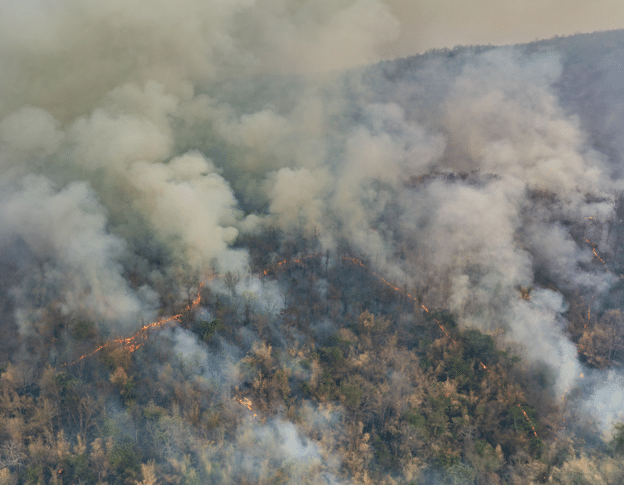
Why It Matters: Wildfires across North America cause tremendous, localized devastation that impacts both human populations and natural ecosystems relied on by sportsmen and women. Elsewhere, the smoke resulting from largescale wildfires represents a severe threat throughout much of the country due to air quality impacts such as that are currently affecting the Eastern United States. But we, as conservationists, know that good fires can help prevent bad ones and that prescribed fire, along with other active forest management activities, help promote quality wildlife habitat for many species. Recognizing this, the Congressional Sportsmen’s Foundation (CSF) will continue to advocate for policies that promote active forest management and the use of prescribed fire.
Highlights:
- The 2026 wildfire season in both the United States and Canada is impacting communities across the country both directly through active fires and indirectly through widespread smoke and poor air quality.
- The Congressional Sportsmen’s Foundation continues to advocate in support of policies designed to promote active forest management to combat the risks of wildfires, including the bipartisan Fix Our Forests Act.
- Right now, Congressional Leaders, with the support of CSF and members of the sporting-conservation community, are pushing for the inclusion of FOFA in the upcoming National Defense Authorization Act.
Across a large swath of United States, Americans are feeling the impacts of wildfires, either directly or indirectly as smoke pollution continues to spread. These occurrences are becoming increasingly common each fire season due to a variety of factors that the Congressional Sportsmen’s Foundation and partners are working to address.
Fire requires three basic components: fuel, air, and an ignition source. In nature, air is not a limiting factor and, in many cases, is an overly abundant driver when winds increase while ignition during summer can stem from both human-induced and natural sources. This leaves fuel as, arguably, the most critical component of the Fire Triangle relevant to wildfires that humans can actively influence. Particularly true across portions of the American West where active forest management actions have been impaired by ill-informed and misguided litigation efforts, fuels have been allowed to accumulate to unnaturally high levels.
CSF recognizes the role that responsibly implemented activities like regulated timber harvest and prescribed fire can have on reducing fuel loads while significantly improving habitat availability for a variety of species. Many game species benefit significantly from periodic, low intensity fires that reset or arrest succession, promoting abundant forbs and grasses that attract wildlife from pollinators to migratory big game.
The Congressional Sportsmen’s Foundation is proud to join partners in supporting the efforts of Congressional Sportsmen’s Caucus leaders and members to pass the bipartisan Fix Our Forests Act which seeks to streamline opportunities to utilize much needed forest management practices on federal lands where fuel loading and wildfire risks are particularly high. For sportsmen and women, healthy forests mean healthier wildlife populations, improved public access, more resilient watersheds, and better hunting and fishing opportunities for future generations.
As a refresher, the Fix Our Forests Act was passed by the House of Representatives with wide bipartisan support in January while the Senate version of the bill was passed by the Senate Committee on Agriculture, Nutrition, and Forestry late last year and awaits further action. Though progress as a standalone bill has been positive, there is currently a bipartisan effort underway to fast-track the Fix Our Forests Act by including it as an amendment to the National Defense Authorization Act, Congress’ major defense spending bill. Given the role that this legislation would play in protecting Americans from the risks associated with wildfires, along with the frequency with which our armed services members are called into action to assist with issues related to wildfires, CSF and partners are working hard to support this step to ensure that actions with a proven track record of reducing wildfire risk (while also improving wildlife habitat) are available to forest managers across the country.