
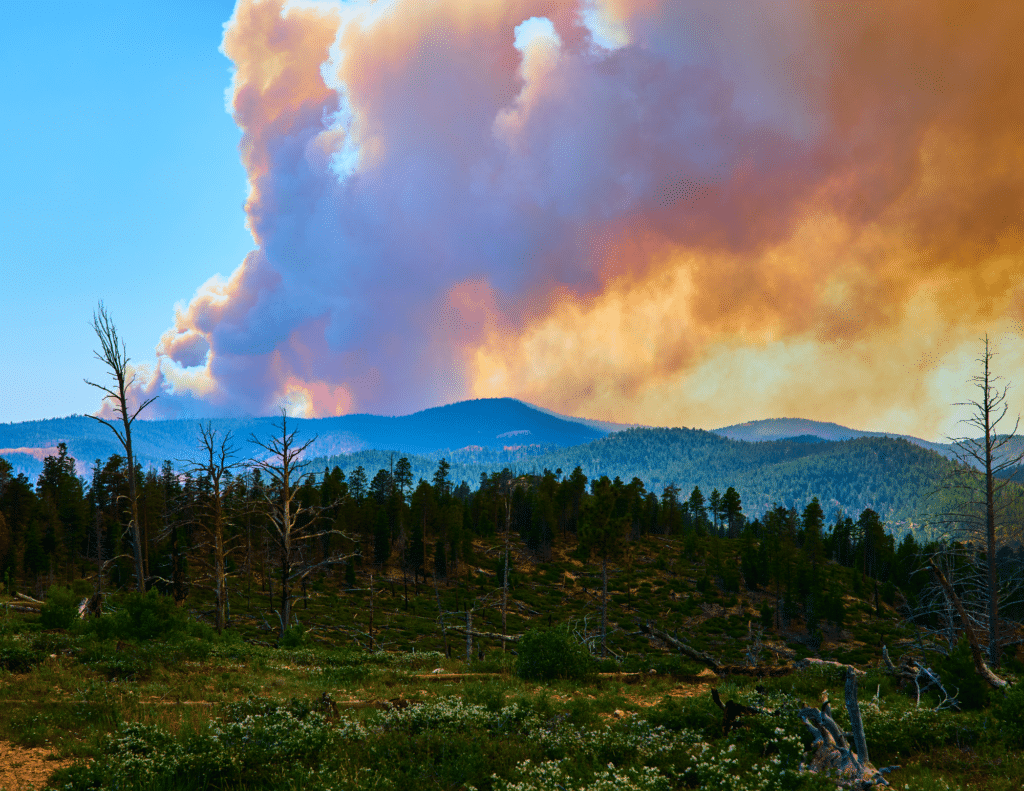
The morning had started perfectly. Frost still clings to the grass in the shadows; the wind is steady in your face, and the timbered ridge across from you glows gold in the first light of day. A perfectly typical 4×4 makes his way up the ridge in your glass. Then you notice it, a thin gray column rising above the horizon.
Smoke.
At first, it’s little more than a wisp. But as the morning wears on, the plume grows taller, climbing into the blue sky beyond the ridge.
For generations, the sight of smoke has triggered alarm, fear, and even panic. Fire has long been associated with destruction, and rightfully so, as our country has recently faced a long string of devastating wildfire seasons. But long before a changed world where million-dollar homes dotted landscapes, fire was shaping the very land on which we pursue wildlife and live. In fact, the healthy forests, productive grasslands, and abundant wildlife habitat we value evolved with and benefited from wildfire.
Today, as America wrestles with these severe wildfire seasons, land managers and sportsmen find themselves confronting an uncomfortable reality: the force we’ve spent more than a century trying to suppress is often the same force that many ecosystems have desperately needed.
A common misconception is that forests naturally progress toward a permanent, ideal condition if left alone. In reality, forests are constantly changing. Disturbance can drive those changes towards good, and for much of North America, fire has been one of nature’s most important tools.
Many of our most iconic ecosystems evolved alongside recurring wildfires. Ponderosa pines can withstand frequent, low-intensity burns. Giant sequoias rely on fire to help create conditions suitable for regeneration. Across the Great Plains, native grasses evolved with periodic burning that removes old vegetation and stimulates fresh growth. Wildlife evolved with fire, too. Anyone who has hunted a burn a few years after a fire understands why.
New, nutrient-rich vegetation often erupts from the ashes, attracting mule deer and elk. Wild turkeys forage through open understories. Quail find improved habitat. To wildlife, a burned landscape is often less a catastrophe than a reset button.
Long before Europeans arrived, Native Americans across North America understood something deeply: fire could be a powerful management tool.
Native American tribes intentionally burned forests, grasslands, and shrublands to improve hunting opportunities, encourage desirable plants, reduce hazardous fuels, and create habitat for game species.
Many of the open forests and productive wildlife landscapes described by early explorers were not untouched wilderness. They were landscapes shaped by generations of inspiring and intentional stewardship.
In the summer of 1910, following months of drought, hundreds of fires burned across the Northern Rockies. When strong winds arrived, these small fires merged into an unstoppable firestorm that swept across Idaho, Montana, Washington, and neighboring states. Entire communities were destroyed. Firefighters and civilians lost their lives. Millions of acres burned in what became known simply as the Big Burn. This catastrophic disaster occurred at a pivotal moment. The U.S. Forest Service was still a young agency, and the Big Burn cemented a philosophy that would dominate wildfire management for decades: every fire was a threat, and every fire should be extinguished as quickly as possible.
By the 1930s, that philosophy became formalized through the Forest Service’s famous “10:00 a.m. Rule,” which directed firefighters to suppress every wildfire by 10:00 a.m. the day following its discovery. Fire had become the enemy, and America went to war against it.
The “all fire is bad fire” messaging was only reinforced by the highly successful campaign through the iconic Smokey Bear, which actually proved successful in lowering human-caused fires, but also reinforced the danger and fear of fire to the general public.
Without recurring fire, small trees filled gaps beneath larger ones. Surface fuels accumulated year after year. Meadows slowly filled with conifers. Shrubs expanded into grasslands. At the same time, many forests became increasingly vulnerable to insects, disease, and drought stress. Researchers eventually arrived at a “surprising” conclusion. The absence of fire was creating problems of its own.
As scientific understanding evolved, prescribed fire emerged as an increasingly important management tool. Rather than waiting for wildfire to ignite under extreme conditions, managers could intentionally apply fire under carefully controlled weather and fuel conditions. The benefits of this are difficult to ignore.
Prescribed fire reduces fuel accumulations. It stimulates forage production. It improves habitat diversity. It restores natural processes that many ecosystems evolved with. But reintroducing fire isn’t always easy.
With the previous absence of fire, many forests today are far denser than they were historically. Decades of fuel accumulation have left some stands loaded with ladder fuels. Insect outbreaks and disease have weakened millions of acres. Drought stress has become increasingly common. That’s the predicament land managers often find themselves in today. The landscape needs more fire, and yet decades of suppression have often made fire harder to safely apply. That challenge is one reason timber management remains central to modern forest policy discussions.
Following World War II, the Forest Service dramatically expanded timber production to meet growing national demand. Harvests increased through the post-war housing boom and remained high through much of the second half of the twentieth century, peaking from roughly the 1960s through the late 1980s.
However, beginning around 1990, federal timber harvests declined sharply amid changing policies, litigation, evolving public priorities, and landmark conservation decisions associated with species protection and ecosystem management. Since then, timber outputs on federal lands have remained far below historic highs: another massive challenge.
This combined lack of management has left us with severely overstocked forests and fuel loading, which has significantly increased the risk of catastrophic fire. This is not good news for fish, wildlife, public access, or communities.
Efforts such as the bipartisan Fix Our Forests Act, which is strongly supported by the Congressional Sportsmen’s Foundation (CSF), seek to bolster active forest management to address the restoration needs on the more than 117 million acres of fire-prone forests. The legislation is critical to reducing catastrophic wildfire risk and increasing forest resiliency to support the outdoor sporting traditions of millions of sportsmen and women who depend on federal public lands for recreational access. The Fix Our Forests Acts is a top priority for CSF and others in the sporting-conservation community.
The current Administration has likewise emphasized increasing active management and fuels reduction efforts on federal lands.
While debate over specific policies will continue, there is agreement on one point: the scale of the challenge we face here demands action. The Congressional Sportsmen’s Foundation, the leading authority in advocating for sportsmen and women in the halls of government, continues our work to ensure the sporting-conservation community is part of the decisions being made about how America’s forests are managed. After all, we are the ones outdoors.
In the end, this isn’t just a policy conversation or a debate. This will affect the kind of landscapes we leave behind and whether the next generation will know the same feeling we do now, sitting behind a tripod at first light, glassing the ridge, and watching the landscape come alive. The land we leave behind will never lie about what we chose to do. That is something worth fighting for.