
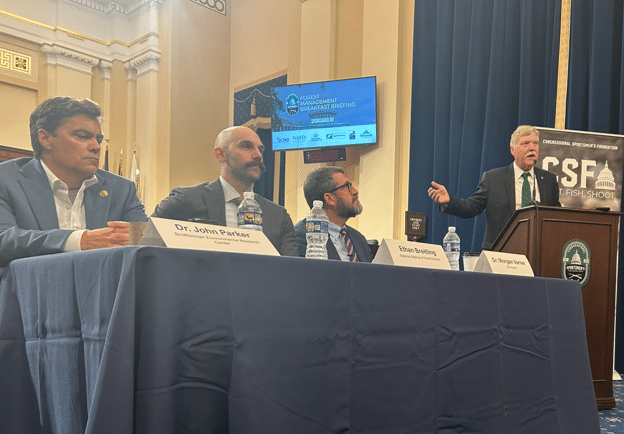
Why It Matters: Educating federal policymakers about the challenges impacting private working forests and federal forests is key to advancing policy solutions to support healthy forests and wildlife habitat. The forest industry and the sportsmen’s community share goals for forest resiliency and conservation. Highlighting these shared priorities at a briefing helps move the needle on policies to improve the management of federal lands and support the long-term sustainability of private working forests.
Highlights:
- Declining forest markets were identified as one of the biggest challenges facing private working forest landowners and an impediment to improving forest health on federal public lands.
- Bolstering innovative markets for low-value wood is critical to increasing the pace and scale of forest restoration on federal lands and preventing private forest conversion to non-forest uses.
- Speakers emphasized the importance of science-based forest management practices – including timber harvest, thinning, and prescribed fire – to reduce hazardous fuels, increase forest resilience to wildfire, and improve wildlife habitat.
On June 10, the Congressional Sportsmen’s Foundation (CSF) hosted a policy briefing on Capitol Hill to discuss one of the most critical factors impacting wildlife habitat – forest management. With more than 40 congressional staff and conservation partners in attendance, the Forest Management Breakfast Briefing provided an opportunity for experts from the forest industry, wildlife management professionals, and leaders from the sportsmen’s community to discuss challenges facing private working forests and federal forests, as well as programs and policies to support forest sustainability and habitat management for wildlife.
Congressional Sportsmen’s Caucus Co-Chair Congressman Bruce Westerman opened the briefing by discussing the importance of active forest management to fish and wildlife conservation, forest resiliency, the economy, and hunting and fishing traditions. Congressman Westerman also advocated for the passage of CSF-priority legislation, the Fix Our Forests Act (FOFA) (S. 1462), which passed the Senate Committee on Agriculture, Nutrition, and Forestry in October 2025 with strong bipartisan support. The House version of FOFA (H.R. 471), led by Congressman Westerman, cleared the House 279-141 in January 2025.
Along with CSF’s Director of Forest Policy, speakers included CSF Board of Directors Member Brian Luoma; Ethan Breitling, Vice President for Strategic Communications, National Alliance of Forest Owners (NAFO); Dr. John Parker, Senior Scientist, Smithsonian Environmental Research Center (SERC), and Dr. Morgan Varner, Director of Research, Tall Timbers. Speakers discussed policy priorities to address declining markets for low-value timber, threats from severe wildfires and other natural disasters, land use competition, and policies limiting active forest management, including prescribed fire, on private and public lands.
CSF would like to thank the speakers as well as the sponsors for the briefing: Green Diamond, NAFO, SERC, Tall Timbers, Theodore Roosevelt Conservation Partnership, and The Westervelt Company.